California Natives · Series Kickoff · No. 01
A field guide to Epilobium canum, the drought-tolerant California sub-shrub that hits its scarlet-orange stride in August, right when the rest of the native garden has gone quiet.
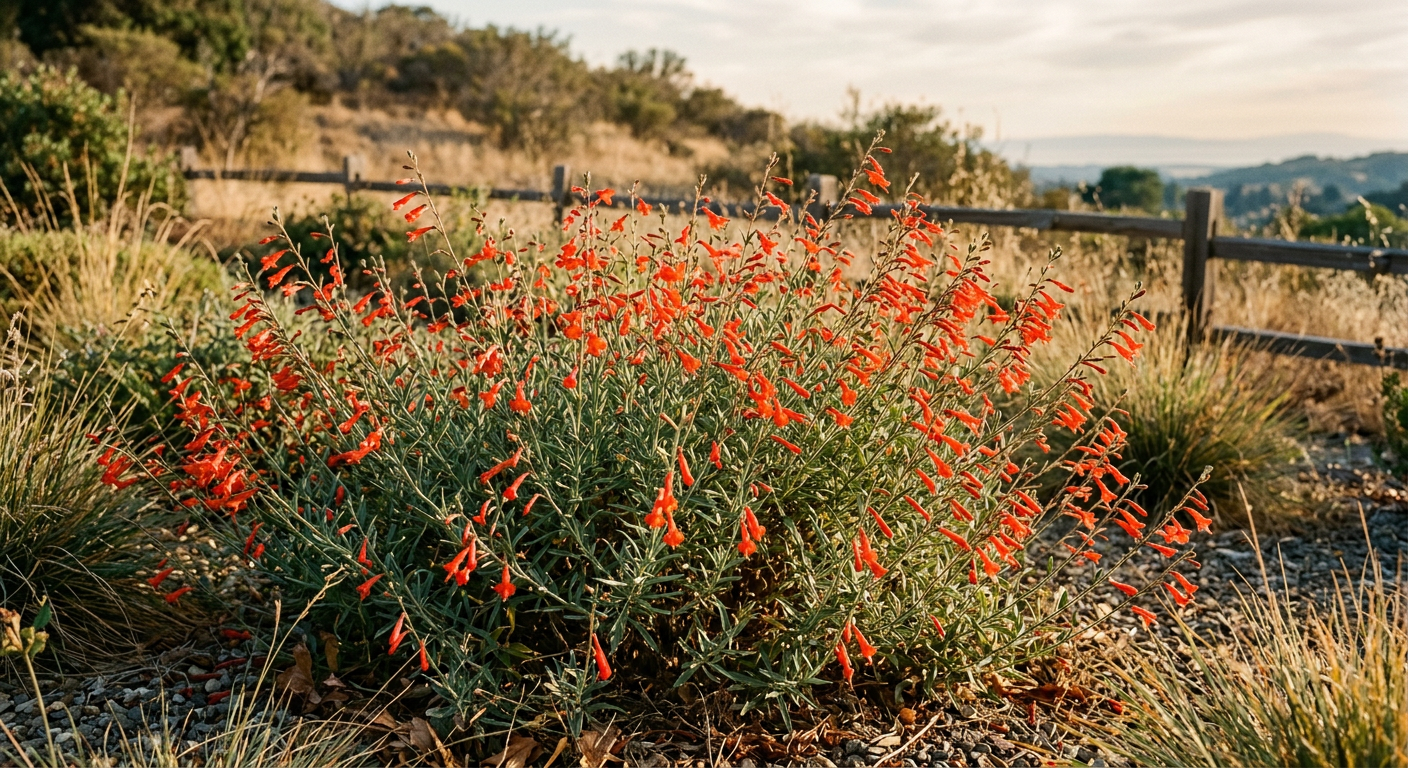
California Fuchsia is the plant that holds the show when the rest of the native garden has gone quiet. By August, most California natives have set seed and entered summer dormancy. Manzanita stopped blooming weeks ago. The poppies are long gone. The lupines are crisp brown skeletons. Then Epilobium canum pushes its first flush of scarlet-orange tubular flowers, and your garden has a focal point again right when you needed one.
It's a sub-shrub in the evening primrose family (Onagraceae). Older nurseries and garden books may still list it as Zauschneria californica; current botanical convention treats it as Epilobium. The plant is the same.
What makes it worth knowing isn't the bloom itself, though the bloom is gorgeous. It's the timing. This is the plant that bridges the gap between summer dormancy and the first fall rains, and in a Bay Area garden built around natives, that bridge is the difference between a yard that looks abandoned in August and one that's still alive.
A mature California Fuchsia runs one to three feet tall (30 to 90 cm) and spreads two to four feet wide (60 to 120 cm). The form is loose and sprawling, not a tight shrub. Leaves are narrow and gray-green to silver, often with a slightly fuzzy texture that helps the plant retain water in dry heat.
The flowers are the whole point. Each one is a tubular, slightly curved trumpet about an inch to an inch and a half long (2.5 to 4 cm), scarlet-orange to bright red, with four notched petals splaying at the mouth. They emerge on slender stems that rise just above the foliage. A well-established plant in peak bloom can carry hundreds of flowers at once, and the effect is closer to a fire than a flower border.
Underground, the plant spreads via rhizomes: horizontal stems running just below the soil surface that send up new shoots as the patch expands. A specimen you plant this fall will be a noticeably larger patch by next summer, and a different shape than what you planted.
California Fuchsia is native to dry slopes, rocky outcrops, and disturbed areas across the California Coast Ranges and Sierra foothills, with populations extending north into southern Oregon and south into Baja California. Within California, it's especially visible in the dry hills of the Diablo Range and the Santa Cruz Mountains.
The native habitat tells you what it expects. Lean soils. Sharp drainage. Full sun. Dry summers, wet winters. Replicate any of that in your garden and the plant performs. Give it the opposite (heavy clay that holds water, afternoon shade, summer irrigation) and it sulks.
Two subspecies are commonly seen in the nursery trade: subsp. canum and subsp. latifolium. Garden-selected cultivars include 'Calistoga', 'Catalina', and 'Everett's Choice', each chosen for habit, bloom intensity, or compactness.
Most gardeners discover California Fuchsia in spring at a native plant sale, take it home, plant it, and then panic by June because nothing's happening. The foliage looks fine but there are no flowers. The plant looks small. There's no obvious reward for the space it's taking.
This is normal. California Fuchsia is a late-summer to fall bloomer. Its peak window is August through October, sometimes pushing into early November in coastal microclimates. A plant that looks unremarkable in June will look extraordinary in September. If you plant one in spring and pull it in July because it isn't performing, you've made the one mistake this plant punishes.
The fix: plant in fall, not spring. Fall planting gives the root system a full wet winter to establish before the first summer drought, and by year two the plant is on its full bloom cycle. California Native Plant Society (CNPS) chapter plant sales in October and November are the right window for getting one into the ground at the right time.
Six hours of direct sun is the minimum for full bloom. Eight is better. In a Bay Area garden, that means open south, west, or unshaded east exposure. The plant tolerates partial afternoon shade in hot inland gardens like Walnut Creek and the Tri-Valley, where the flowers don't fry as fast and bloom can run longer. Too much shade, though, and bloom drops off sharply. If your California Fuchsia is leggy with sparse bloom, the first thing to check is light, not water.
For the first growing season after planting, water deeply once a week through the dry months. That gets the root system down. After year one, the plant wants almost nothing from you. A deep soak once a month in July and August is plenty; many established plants do fine on natural winter rain only.
The mistake to avoid is summer irrigation. Frequent shallow watering can rot California Fuchsia. It evolved on dry slopes where water came in winter and was gone by May, and its physiology assumes that pattern. Water it like a tomato and it'll die telling you so.
Sharp drainage matters more than soil chemistry. California Fuchsia tolerates rocky, gravelly, sandy, or serpentine soils (mineral-heavy, magnesium-rich substrates derived from California's serpentine bedrock; toxic to most plants but welcome to natives that evolved on them). Even poor soils suit it fine. What it does not tolerate is heavy clay that stays wet. On Bay Area adobe clay, plant on a slope or in a raised area where water moves through, or amend with coarse pumice or decomposed granite to open up drainage. Skip the compost amendment. Rich soils make California Fuchsia floppy and reduce bloom intensity.
California Fuchsia is hardy to roughly 10–20 °F (–12 to –7 °C) across USDA (United States Department of Agriculture) Plant Hardiness Zones 8 through 10, depending on subspecies and cultivar. That covers all but the coldest microclimates in California and most of the inland West Coast. In colder zones it dies back to the rhizome in winter and re-emerges in spring. In milder coastal areas the foliage may persist year-round but in a tired-looking state. Cut it back hard in late winter, February in the Bay Area, before new growth pushes.
In my experience, the rhizomes are the part you'll have an opinion about by year three. A well-sited California Fuchsia spreads outward over time, and on rich, irrigated, or otherwise hospitable soil it can become enthusiastic. That's great if you have a slope to fill, a parking strip to colonize, or a meadow planting where spread is the point. It's less great if you put it in a tight border next to a more delicate native and expected it to stay where you put it.
Put California Fuchsia somewhere it can actually spread: a bank, a meadow, an unedged border. Then the spreading reads as success rather than a problem.
The right time to get California Fuchsia in the ground is October through early December, before the winter rains start in earnest. Plants installed in fall use the wet season to root in and are ready for their first summer with an established system. Spring planting works but you'll baby it through the first dry season.
For ethically sourced, correctly identified material, go to your local CNPS chapter plant sale. In the Bay Area, that means the Santa Clara Valley chapter (typically October), the Yerba Buena chapter in San Francisco, and the East Bay chapter. These sales are propagated from regional native stock and staffed by people who can tell you which subspecies suits your conditions. Local California native specialty nurseries also carry California Fuchsia year-round; check current availability before driving anywhere.
Don't dig wild plants from public land. Beyond being illegal in most places, wild-collected plants establish poorly compared to nursery propagation, and the ecological cost is real.
California Fuchsia is the plant you put in this fall to make next August's garden worth walking into. Site it right, water it through the first season only, and stop fussing. Plant it now. Walk past it all summer year one. Year two it pays you back, every August, for the rest of the plant's life. A fire of red-orange flowers when nothing else is offering them.
Sources
Bornstein, C., Fross, D., & O'Brien, B. (2005). California native plants for the garden. Cachuma Press.
California Native Plant Society. (n.d.). Epilobium canum subsp. canum (California Fuchsia). Calscape. Retrieved May 20, 2026, from https://calscape.org/Epilobium-canum-ssp.-canum-(California-Fuchsia)
Fenster, C. B., Armbruster, W. S., Wilson, P., Dudash, M. R., & Thomson, J. D. (2004). Pollination syndromes and floral specialization. Annual Review of Ecology, Evolution, and Systematics, 35, 375–403.
Grant, K. A., & Grant, V. (1968). Hummingbirds and their flowers. Columbia University Press.