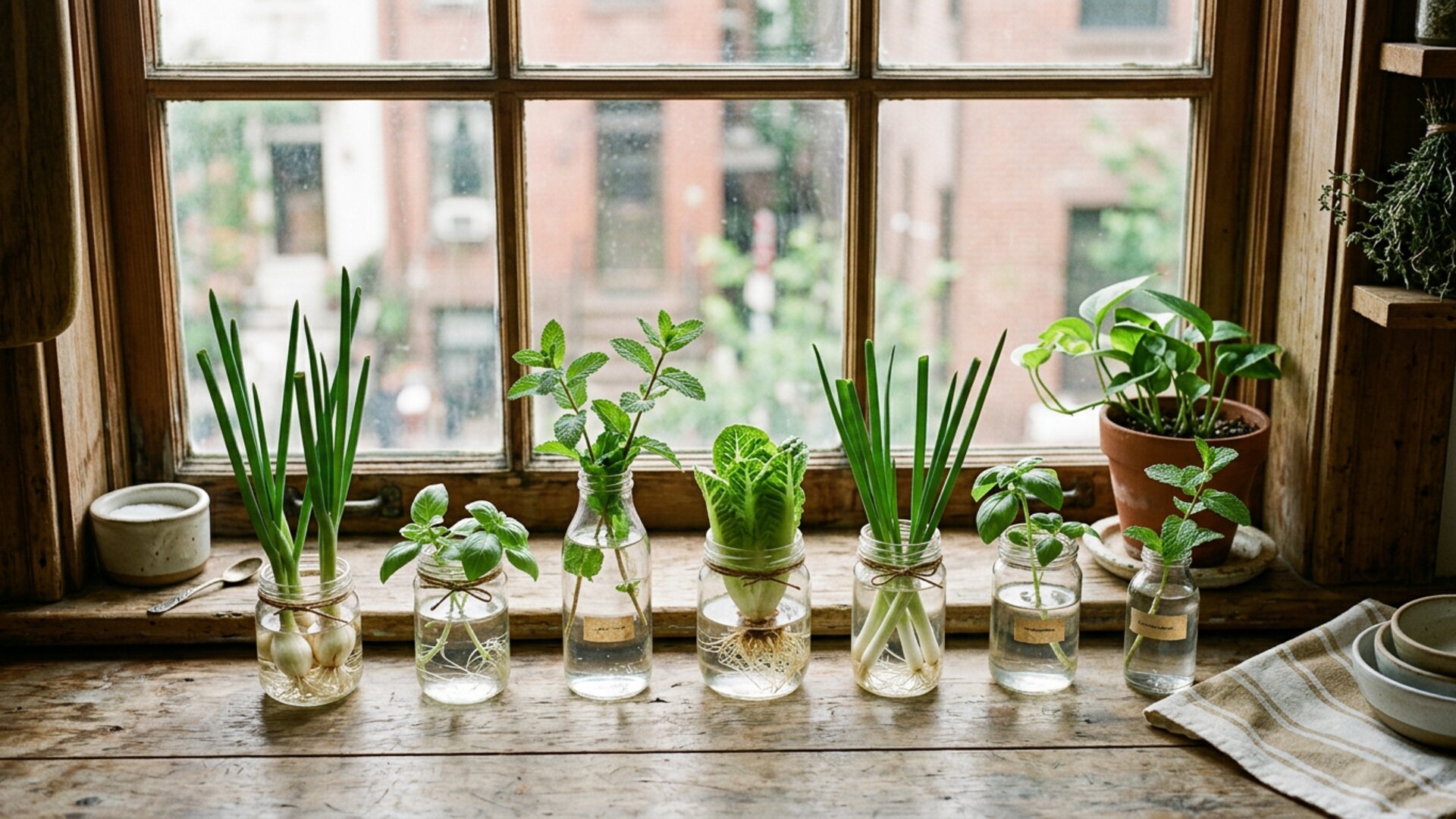
Your $3 basil from Trader Joe's isn't done with you yet. Turn grocery store herbs into free plants with nothing but a glass of water and a sunny window.
The cheapest way to start a balcony herb garden isn't to buy plants. It's to buy herbs you were going to buy anyway and turn the leftovers into plants.
Not every herb cooperates. Rosemary, thyme, and oregano can root from cuttings but they're slow and finicky. Soft-stemmed herbs? They practically demand to root in water. These three work reliably on any sunny windowsill, including a warm Bay Area one.
1Basil
Beginner · 2–3 weeks to potted plantBuy: A bunch of fresh basil from the grocery store produce section. The kind that's still on the stem, not pre-torn leaves.
What to do
- Pick the freshest-looking stem with at least four inches of length.
- Pinch off the bottom leaves so the bottom two inches of stem are bare.
- Put it in a glass of water with just the bare stem submerged — leaves stay dry.
- Set it on a sunny windowsill. Change the water every 2–3 days.
- Roots should appear in 7–14 days. Wait until they're at least an inch long before potting.
Basil is the poster child for this technique. One bunch of grocery basil easily gives you 3–4 cuttings, which means 3–4 free plants. In our climate, potted basil outside produces from April through October without complaint.
2Green Onions (Scallions)
Beginner · Harvest in under a weekBuy: A bunch of green onions. You want the ones with visible white bulbs and intact roots, not trimmed-off roots.
What to do
- Use the green tops as you normally would in cooking.
- Keep the bottom two inches — the white bulb plus the root threads.
- Put those root-end-down in a shallow glass of water. About an inch of water is plenty.
- Sunny windowsill. Change the water every few days.
- New green tops start pushing up within days. You can keep cutting the tops indefinitely — the bulbs will keep regenerating.
This is honestly the easiest kitchen project I know. You'll see new green within 48 hours. Move them to a small pot of soil once the roots are established and you'll extend their productive life significantly. But the glass version works fine on its own for a month or two.
3Mint
Beginner → Easy · 7–10 days to rootsBuy: A bunch of fresh mint from the produce section, ideally the brightest-green, freshest-looking bunch you can find.
What to do
- Same as basil: pick healthy stems, strip the bottom leaves, put the bare stem in water.
- Mint roots faster than basil in my experience — you'll often see root nubs within 5–7 days.
- Once roots are an inch long, pot it. Use its own pot. Mint will take over anything you plant it with.
Serious warning: mint is a thug. Never plant mint in a pot with other herbs. It will outcompete and eventually smother anything sharing its root space. Always its own pot. Always.
Aside from its territorial ambitions, mint is the most forgiving of the three. It handles partial shade, forgives forgotten watering, and grows fast enough that you'll be giving cuttings away within a few months.
If Your Windowsill Isn't Delivering
Not every apartment gets the kind of window that makes this easy. My indoor collection runs mostly on grow lights—Barrina T5 strips and puck lights on 11-hour timers. Cuttings root just as well under artificial light as they do on a south-facing sill. If your windowsill isn't getting four or five bright hours a day, a cheap T5 strip 8–12 inches above the jars will close the gap. You don't need a full rig. One cool-white strip over a kitchen counter is enough.
Why This Works
Soft-stemmed herbs like basil, mint, and scallions can produce adventitious roots (new roots that form directly from stem tissue) when the right conditions are met: moisture, warmth, light, and a stem node in contact with water (Hartmann, Kester, Davies, and Geneve, Plant Propagation: Principles and Practices, 9th ed., on adventitious rooting). Grocery store herbs are cut just hours before you buy them, so the stem tissue is still alive and ready to regrow.
The same technique works on pothos, philodendron, tradescantia, and dozens of other houseplants. If you've ever wondered how plant people build a collection without spending much money, this is most of the answer.
A Note on Our Climate
Here in the Bay Area, once rooted herbs move to a balcony pot, they're in business from April through October with minimal fuss. Mint can even overwinter outdoors in most of Santa Clara County, where the climate sits at USDA hardiness zones 9b/10a (USDA Plant Hardiness Zone Map; UC ANR home garden publications). Basil won't (it's an annual), but you can get five or six months of production from a $3 bunch. That's a pretty good return.
Keep going · The Window Box
Once your free herbs are rooted, where do they go?
If you're moving rooted cuttings into a balcony pot for the summer, the next read is the Window Box's full balcony tomato guide — same approach, bigger payoff. Or if you're keeping it all indoors on a windowsill, the substrate guide is what saves your potted herbs from drowning.
Try How to Grow Tomatoes on a Balcony or Why Your Plants Keep Dying in Perfectly Good Soil.
UC Agriculture and Natural Resources. (n.d.). Home garden publications. https://anrcatalog.ucanr.edu/
U.S. Department of Agriculture, Agricultural Research Service. (n.d.). USDA Plant Hardiness Zone Map. https://planthardiness.ars.usda.gov/